
In-house, outsource or hybrid? How to build a Marketing function that actually works.
The short answer.
The right marketing model for a growing business depends on one thing: whether your brand strategy and marketing foundations are already in place. If they are, hiring in-house or engaging an agency can work well. If they’re not, the smartest move is to build the foundations first - then hire into them. Most businesses get this sequence wrong and it costs them.
Most businesses ask the wrong question.
Your business is growing. Sales are working. And now it surfaces - in a leadership meeting, from the board or just as a nagging feeling - what are we actually doing about marketing?
Someone asks: “Should we hire a marketer or bring in an agency?”
It feels like the right question. It isn’t. The real question is: do we have what either one needs to succeed?
There are three paths. Each one works - but only under the right conditions. Getting the sequence wrong is an expensive mistake a growing business can make.
Option A: Hire in-house.
Hiring a marketer feels like the serious move. Someone dedicated, embedded, aligned with the business. And it can be exactly that - when the timing is right.
When it works: When your brand is already defined, your strategy is in place and you know precisely what kind of marketer you’re hiring for.
Where it goes wrong:
You hire before the strategy exists and your new marketer spends six months building the plane while flying it.
You need five skill sets but only have budget for one, so you hire a generalist who can’t go deep on anything.
The CEO or GM is still carrying the strategic load, just with an extra salary on the books.
In-house is a later-stage move. The mistake is treating it like a first one.
Option B: Outsource to an agency.
Agencies offer speed, scale and specialist capability - design, media, content - ready to go. For businesses with clear direction, they can be genuinely powerful.
When it works: When you have a defined strategy, a strong internal owner and just need execution horsepower.
Where it goes wrong:
Agencies execute. But the strategic direction still has to come from inside the business and if that clarity doesn't exist yet, even the best agency will struggle to deliver.
Without an internal owner, accountability sits with whoever has the least time for it, usually the CEO.
When the engagement ends, momentum often stalls because there’s no internal capability to hand off to.
Agencies are amplifiers. Give them something worth amplifying.
Option C: The hybrid model - build, then hire.
This is the most overlooked path and often the one that works best for growing businesses building a marketing function for the first time.
The logic is simple. Instead of hiring a marketer before the strategy exists - or briefing an agency that expects you to have one - you build the foundations first. Brand, strategy, messaging, customer clarity, plan, process. You implement it. Then you hire the right person to own it.
When it works: When you’re serious about building something that lasts, not just filling a seat or outsourcing the problem.
What makes it different:
You only hire when the structure exists to support them
No “unicorn hire” pressure - the role is scoped around a real strategy and set of skillsets, not a wish list
Costs the equivalent of a single marketer’s salary
The honest trade-off: you have to be willing to slow down to speed up. This isn’t a quick fix. But it’s the one that doesn’t need fixing again in twelve months.
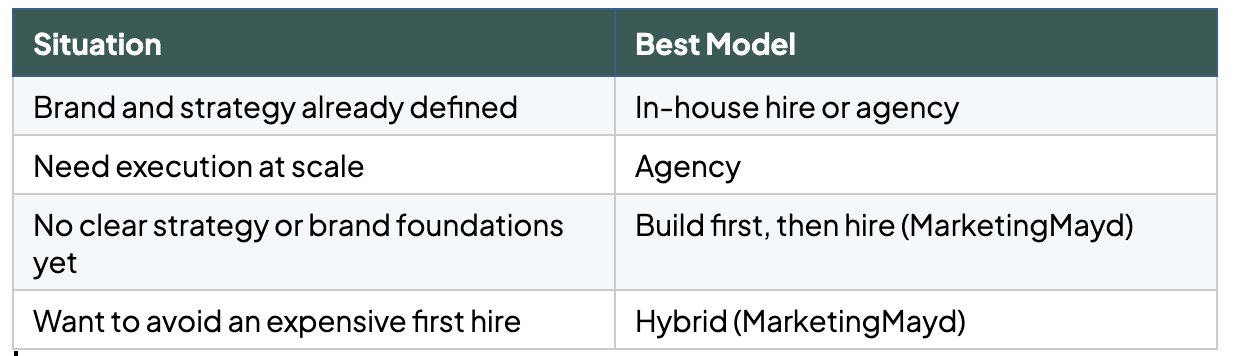
So which model is right for your business?
Most businesses default to “who should we hire?” The better question is: what does our business actually need for that hire to succeed?
The bottom line.
The sequence matters more than the model. Build the foundations first — brand, strategy, plan — and every model works better. Skip them, and every model gets expensive.
Same budget. Smarter sequence. Stronger outcomes.
Mayd offers MarketingMayd for businesses that want to build their marketing function before hiring into it. One year. The expertise of an entire marketing team. The cost of a single hire. Learn more.